
1. Why Does Powder Handling Require a Controlled Environment?
Powder materials are widely used in materials science, powder metallurgy, battery research, catalyst preparation, and pharmaceutical development. However, many powders have a large specific surface area and are sensitive to moisture, oxygen, and environmental contaminants.
During open-air handling, powders may absorb moisture and form agglomerates, undergo oxidation that alters their surface chemistry, or generate airborne particles that cause sample contamination and potential operator exposure. For highly reactive, flammable, or toxic powders, environmental control is also essential for process safety.
A glove box provides an enclosed workspace and can be equipped with drying, inert gas purging, or gas purification systems to create a controlled environment suited to specific material requirements. This helps improve material stability, operational consistency, and experimental reproducibility.

2. Key Benefits of Glove Boxes for Powder Handling
2.1 Moisture Control to Prevent Absorption and Agglomeration
Hygroscopic powders can absorb moisture from the surrounding air through surface adsorption, capillary condensation, or deliquescence. This may cause particle adhesion, agglomeration, reduced flowability, and changes in chemical properties.
These changes can affect weighing accuracy, mixing uniformity, dispersion, and subsequent processing. For example, certain inorganic salts, pharmaceutical raw materials, and battery materials have strict moisture control requirements, as even trace amounts of water may affect processing or final material performance.
Depending on the moisture sensitivity of the material, a glove box can be equipped with desiccants, dehumidification modules, or gas purification systems to reduce moisture levels and minimize exposure to ambient humidity.
For applications requiring stringent moisture control, dew point or moisture content should be considered rather than relying solely on relative humidity. Dew point and moisture concentration are generally more suitable indicators for evaluating moisture control under very dry conditions.
2.2 Oxygen Control to Protect Air-Sensitive Materials
Certain metal powders, reactive materials, and sensitive catalysts readily react with oxygen. Oxidation may alter their surface composition, catalytic activity, electrical conductivity, or subsequent processing performance.
For highly reactive metals and some ultrafine powders, oxidation may also generate heat and increase the risk of combustion.
A glove box can reduce oxygen levels through inert gas purging. For processes requiring long-term oxygen control, a gas purification system can continuously remove residual oxygen and moisture to maintain a low-oxygen environment.
The choice between nitrogen and argon should be based on the chemical properties of the material. For materials that may react with nitrogen, argon or another suitable inert gas should be considered.
2.3 Dust Containment and Cross-Contamination Control
Powder handling operations such as pouring, weighing, mixing, and transferring can generate airborne particles. Open handling may contaminate the laboratory environment and introduce unwanted particles into other samples or production batches.
A glove box confines powder handling within an enclosed workspace, helping reduce the release of airborne particles and the entry of external contaminants.
For high-purity materials or multi-product, small-batch operations, contamination risks can be further reduced through dedicated work areas, separate tools, controlled material transfer procedures, and appropriate internal cleaning practices.
It is important to note that a standard glove box is not equivalent to a dedicated dust collection system or a certified toxic-material containment system. When handling toxic, sensitizing, or combustible powders, appropriate containment, filtration, exhaust, and protective measures should be selected based on a thorough risk assessment.
2.4 Improved Stability in Weighing and Sample Preparation
High-precision powder weighing can be affected by air currents, static electricity, temperature and humidity fluctuations, and moisture absorption by the sample.
A glove box reduces interference from external air currents and helps minimize sample mass changes caused by exposure to ambient air. An analytical balance can be integrated according to the application requirements, with careful consideration of its suitability for use inside the controlled environment.
However, a glove box does not automatically eliminate static electricity or guarantee weighing accuracy. Glove materials, grounding methods, airflow conditions, and the suitability of the balance for the operating environment should all be considered during system design.
3. Recommended Glove Box Configurations for Different Powder Applications
Powder Type | Main Requirements | Recommended Configuration |
Conventional ceramic powders and non-sensitive inorganic powders | Dust containment and reduced external contamination | Basic enclosed glove box |
Hygroscopic inorganic salts and pharmaceutical raw materials | Moisture control | Desiccant or dehumidification module |
Easily oxidized metal powders and air-sensitive catalysts | Oxygen control | Inert gas purging or gas purification system |
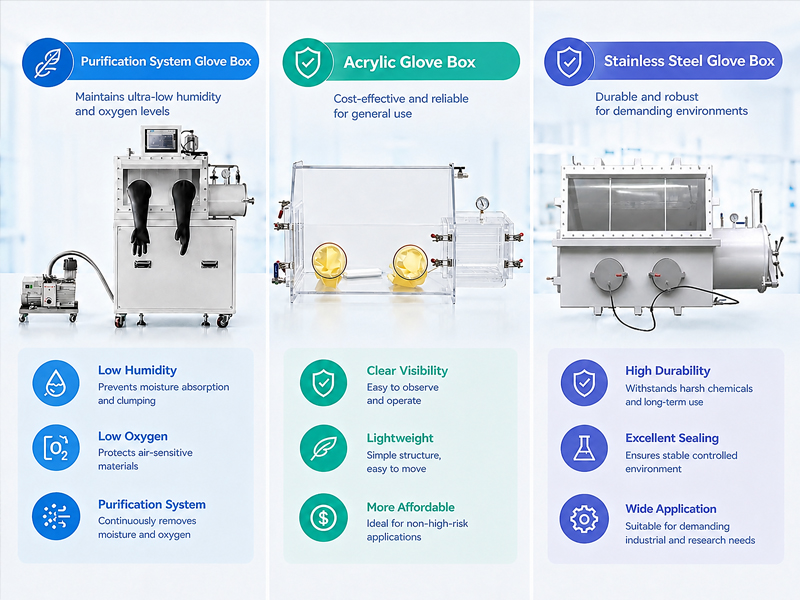
Battery and functional materials sensitive to both moisture and oxygen | Strict moisture and oxygen control | Gas purification glove box |
High-purity or multi-product powders | Cross-contamination prevention | Easy-to-clean interior, optimized layout, and dedicated tools |
Flammable, toxic, or highly reactive powders | Containment and specialized safety controls | Application-specific protective system based on risk assessment |
For materials requiring simultaneous moisture and oxygen control, a gas purification glove box is generally more suitable for maintaining a continuously controlled low-moisture, low-oxygen environment.
The actual control specifications should be determined according to the material and process requirements rather than assumed solely from the glove box type.
4. Key Factors to Consider When Selecting a Glove Box for Powder Handling
Powder Properties
Before selecting a glove box, determine whether the powder is hygroscopic, oxidation-sensitive, flammable, toxic, or potentially explosive. Particle size, dust dispersion characteristics, and compatibility with the selected inert gas should also be evaluated.
These factors directly influence the enclosure design, atmosphere control method, and required safety features.
Moisture and Oxygen Control Requirements
Define the required humidity, dew point, moisture content, and oxygen concentration according to the sensitivity of the material and the process. Basic drying applications and high-purity inert atmosphere applications require different system configurations.
Process Requirements and Workspace Layout
Weighing, mixing, grinding, and material transfer have different requirements for internal workspace, visibility, glove positioning, and equipment layout.
For frequent sample transfers or the use of large containers, the dimensions of the transfer chamber and the material loading and unloading procedures should also be considered.
Cleaning and Cross-Contamination Prevention
Powder residues can accumulate in joints, corners, and on equipment surfaces. When selecting a glove box, consider whether the internal surfaces are easy to clean, whether tools can be easily removed for cleaning, and whether dedicated work areas or equipment are needed for different samples.
Static Electricity and Specialized Safety Requirements
Dry powders may generate static electricity during handling and friction. For combustible dusts or highly reactive materials, grounding, antistatic materials, inert gas protection, dust containment, and equipment protection should be evaluated.
The appropriate safety configuration must be determined by qualified professionals based on material safety data and process-specific risk assessments.
5. Welso Glove Boxes: Supporting Diverse Powder Handling Applications
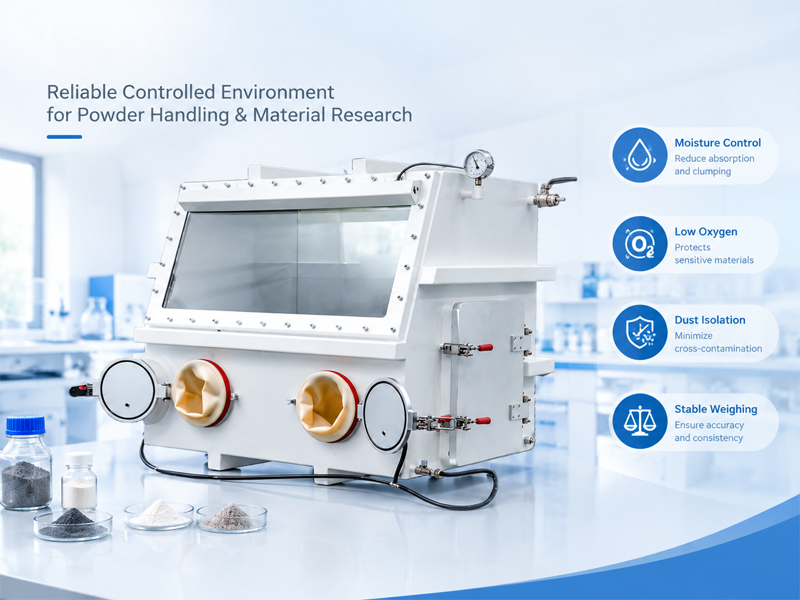
Welso provides glove box solutions for laboratory and materials research applications, with configurations tailored to material sensitivity, operating procedures, and safety requirements.
For applications primarily requiring dust containment and basic moisture protection, a basic acrylic glove box may be considered. For air-sensitive materials requiring oxygen and moisture control, inert gas purging or gas purification solutions can be selected according to process specifications.
With appropriate environmental control and system configuration, glove boxes help minimize the risks of moisture absorption, oxidation, and contamination, providing a more stable and controlled workspace for powder weighing, transfer, preparation, and processing.
Welso — Reliable Controlled Environment Solutions for Powder Handling and Materials Research.



info@welsotech.com
+86 21 51096910
Head Office: No. 439 Jinglian Road, Minhang District, Shanghai,China, 201108
Branch: 1-1009, National Industrial Design Park, No. 599 Jianzhu Road, Binhu, Wuxi , Jiangsu, China, 214062