
Why Is Strict Moisture and Oxygen Control Essential in Solid-State Battery Research?
Solid-state battery materials and cell fabrication processes require stringent environmental control, particularly in battery systems incorporating sulfide solid electrolytes and lithium metal anodes. Certain components of sulfide electrolytes are susceptible to reactions with moisture, potentially altering material composition and releasing hazardous gases. Lithium metal anodes, due to their high chemical reactivity, can undergo surface reactions when exposed to moisture or oxygen, affecting interfacial properties and electrochemical performance.
During solid-state battery research, moisture and oxygen contamination can alter material properties and affect contact conditions between solid electrolytes and electrodes, interfacial stability, and battery testing results. In research involving precise comparisons of material formulations, interface treatments, and cell assembly processes, fluctuations in environmental conditions can increase experimental uncertainty.

Establishing a stable, continuously maintained low-moisture, low-oxygen environment is therefore fundamental to handling air-sensitive materials, preparing electrodes, and assembling solid-state battery cells.
How Do Glove Boxes Meet the Environmental Requirements of Solid-State Battery Research?
Welso glove boxes combine a sealed enclosure, inert gas circulation and purification, and moisture and oxygen monitoring to provide a controlled working environment for air-sensitive materials and battery fabrication. Through inert gas purging and purification, the system reduces moisture and oxygen concentrations inside the enclosure, while continuous monitoring and gas purification help maintain environmental stability.
Depending on equipment configuration, operating conditions, and maintenance status, glove boxes can achieve moisture and oxygen levels in the ppm range or lower, making them suitable for solid-state battery research applications with stringent environmental purity requirements.
In practical applications, glove boxes can support the following key operations:
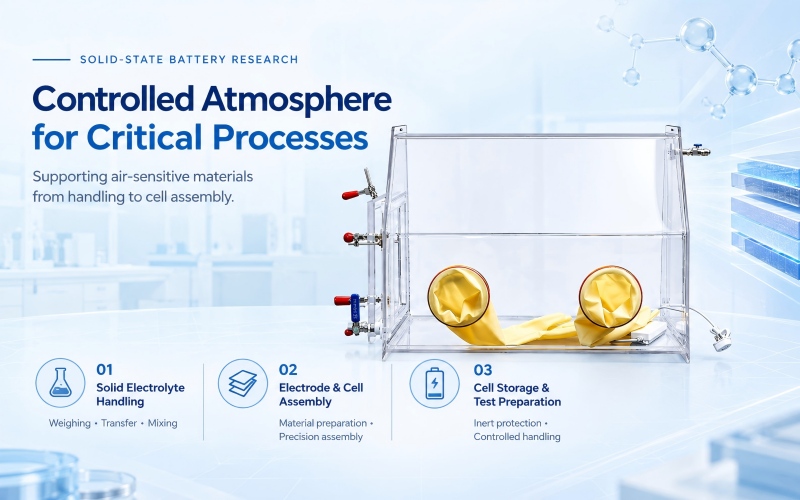
Solid Electrolyte Handling: Supports the weighing, transfer, mixing, and other low-moisture, low-oxygen handling procedures required for sulfide solid electrolytes, helping reduce the risk of material changes caused by environmental exposure.
Electrode and Cell Fabrication: Provides a controlled atmosphere for electrode material handling, solid electrolyte membrane processing, and precision assembly of battery components, helping minimize the effects of moisture and oxygen contamination on materials and interfaces.
Cell Storage and Test Preparation: Provides an inert environment for storing assembled cells and preparing them for subsequent testing, reducing the possibility of contamination during transfer and handling.
The feasibility of performing specific processes inside a glove box depends on the equipment configuration, material system, and process requirements. Operations involving solvents, heating, or spraying also require careful assessment of safety considerations and atmospheric compatibility.
Key Performance Requirements for Solid-State Battery Research Glove Boxes
1. Low Moisture and Oxygen Levels with Long-Term Environmental Stability
For air-sensitive solid-state battery materials, a glove box must not only achieve the target moisture and oxygen levels but also maintain environmental purity throughout operation. An efficient purification system, reliable enclosure integrity, and stable gas circulation and control help minimize the effects of sample transfers, frequent handling, and operational fluctuations on the internal atmosphere.
When selecting equipment, users should evaluate moisture and oxygen control ranges, enclosure leakage rates, atmosphere recovery performance, and long-term operational stability based on their specific materials and processes. For applications requiring moisture and oxygen levels below 1 ppm, it is important to verify that the equipment can meet these specifications under actual operating conditions.
2. Multi-Process Zoning and Flexible Configuration
Solid-state battery research involves different stages, including material handling, electrode preparation, and cell assembly. Each process may have distinct requirements for workspace, atmospheric conditions, and auxiliary equipment.
A zoned layout and modular design allow different work areas and functional modules to be configured according to specific research workflows. This helps reduce interference between processes while providing flexibility for future process adjustments and equipment expansion.
3. Convenient Maintenance and Reliable System Operation
The maintainability and operational reliability of the purification system directly affect glove box efficiency. Modular purification columns, system status monitoring, and fault alerts help users monitor equipment conditions, simplify routine maintenance and troubleshooting, and reduce research interruptions caused by equipment servicing.
Welso Glove Boxes: Supporting Controlled Environments for Solid-State Battery Research
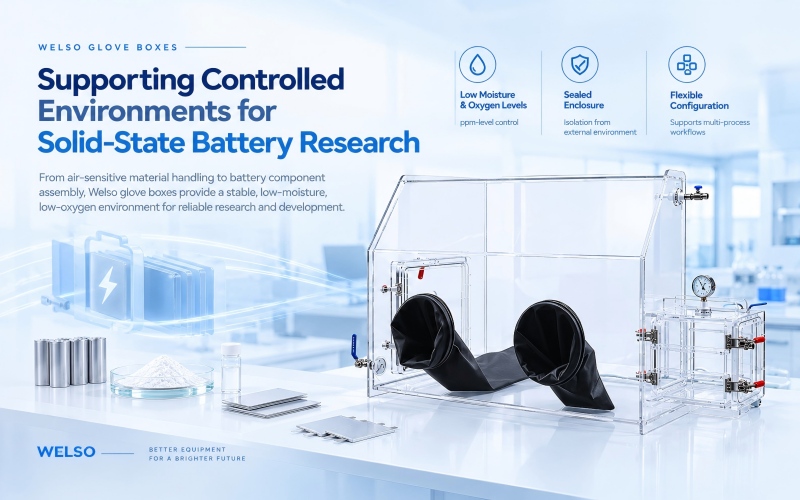
From air-sensitive material handling to battery component assembly, a stable low-moisture, low-oxygen environment is essential for solid-state battery research. Welso glove boxes combine a sealed working enclosure, inert atmosphere purification, and flexible modular configurations to support critical research processes.
By helping minimize moisture and oxygen contamination risks and maintain consistent experimental conditions, Welso glove boxes provide a reliable working environment for materials research, interface optimization, and solid-state battery cell development.



info@welsotech.com
+86 21 51096910
Head Office: No. 439 Jinglian Road, Minhang District, Shanghai,China, 201108
Branch: 1-1009, National Industrial Design Park, No. 599 Jianzhu Road, Binhu, Wuxi , Jiangsu, China, 214062