
Centrifuge rotor adapters are critical accessories that connect the rotor and centrifuge tubes. Their material properties, thickness, and dimensional accuracy directly affect centrifugation stability, sample safety, separation efficiency, and even the reproducibility of experimental results. An inappropriate adapter can lead to tube breakage, sample loss, inaccurate results, rotor imbalance, equipment damage, or even serious safety incidents.
This article provides a comprehensive analysis of how adapter materials and thickness influence laboratory performance and safety, with a highlight on WELSO’s high-performance Nylon rotor adapters.
1. Adapter Material: Determining Strength, Chemical Compatibility, and Long-Term Stability
Common centrifuge rotor adapter materials include plastics (PP, PC, Nylon, Delrin) and metals (Stainless Steel, Aerospace Aluminum). Each material differs significantly in mechanical strength, chemical resistance, thermal stability, weight, and dimensional precision, making them suitable for different laboratory applications.
1.1 Polypropylene (PP) – Standard Laboratory Choice
Key Characteristics:
Excellent toughness, lightweight, cost-effective
Resistant to aqueous solutions, dilute acids/alkalis, and most salts
Autoclavable at 121°C
Suitable for low-temperature storage (-20°C to -80°C)
Impact on Experiments:
Suitable for low- and medium-speed centrifugation (≤15,000 rpm)
Ideal for blood, cell, and biochemical sample processing
Semi-transparent design allows visual inspection
Flexible structure absorbs centrifugal stress, reducing tube breakage risk
Limitations:
Poor resistance to strong organic solvents (DMSO, phenol, chloroform)
Long-term high-speed use may cause deformation
Dimensional changes can reduce balance accuracy
Recommended Applications:
Routine molecular biology, clinical diagnostics, cell culture, and general sample separation
1.2 Polycarbonate (PC) – High-Strength Transparent Material
Key Characteristics:
High mechanical strength and transparency
Good heat resistance and impact resistance
Superior fatigue resistance
Impact on Experiments:
Suitable for medium- and high-speed centrifugation (≤20,000 rpm)
Allows clear observation of pellet formation
Excellent dimensional stability with minimal deformation
Limitations:
Lower solvent resistance than Nylon
Brittleness at extremely low temperatures
Recommended Applications:
Density gradient centrifugation, medium-/high-speed nucleic acid or protein separations, visual monitoring of samples
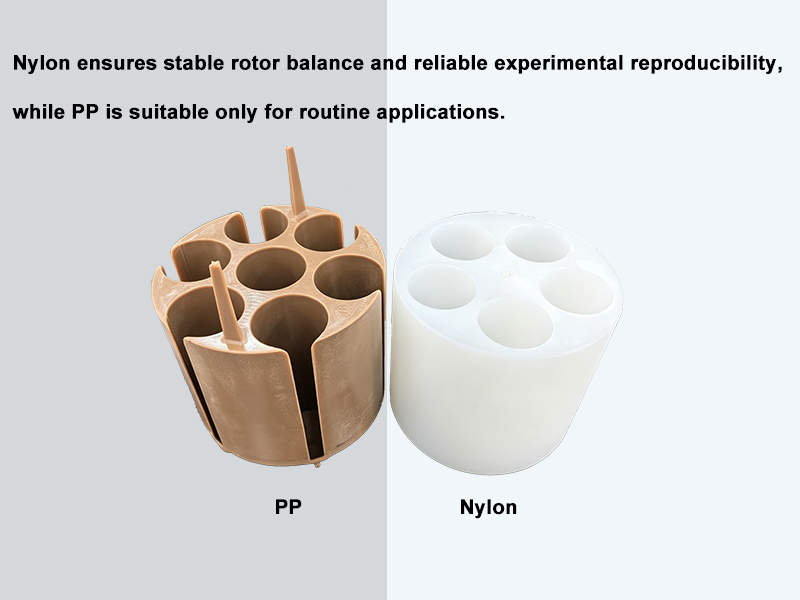
1.3 Nylon (PA) / Delrin (POM) – Wear-Resistant, Solvent-Resistant, Precision Materials
Key Characteristics:
High mechanical strength and wear resistance
Outstanding dimensional stability
Resistant to most organic solvents and oils
WELSO Nylon Rotor Adapters:
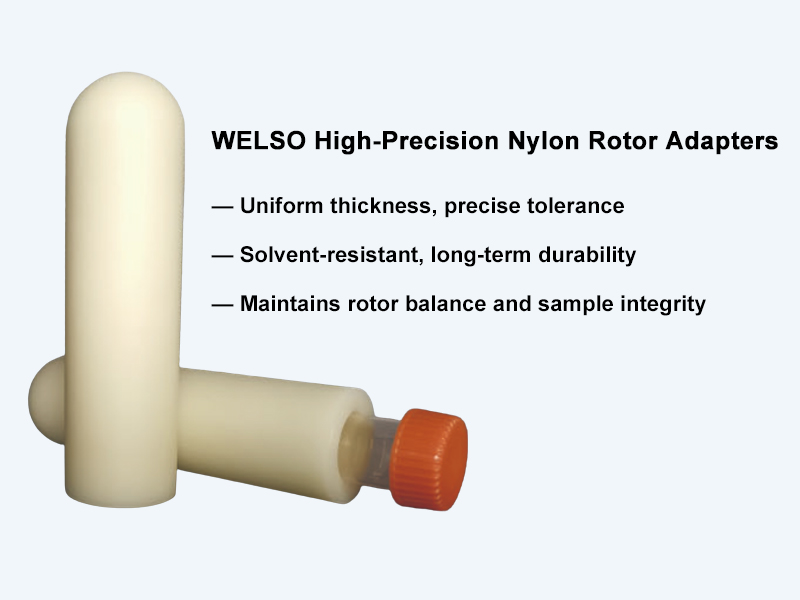
WELSO centrifuge rotor adapters use premium-grade Nylon engineered for precision, durability, and long-term laboratory performance.
Uniform wall thickness and precise tolerances ensure excellent rotor balance even under high-speed or high-frequency centrifugation.
Chemical-resistant properties prevent deformation or swelling when handling organic solvents.
Secure tube positioning minimizes breakage and sample leakage.
Designed for both routine and specialized high-precision experiments, maintaining consistent RCF and reproducible results.
Impact on Experiments:
Ideal for long-term, high-frequency centrifugation
Compatible with solvent-containing samples
Maintains dimensional accuracy and rotor balance
Suitable for precision separation workflows
Limitations:
Heavier than PP and PC
Higher manufacturing cost
Opaque material prevents direct observation
Recommended Applications:
Organic solvent processing, high-throughput laboratories, large-volume rotor conversions, precision centrifugation
1.4 Stainless Steel / Aerospace Aluminum – Ultra-High-Speed Applications
Key Characteristics:
Extremely high strength and rigidity
Virtually no deformation under load
Resistant to most laboratory chemicals
Excellent performance under high/low temperatures
Long service life
Impact on Experiments:
Maximum dynamic balance stability
Suitable for ultra-high-speed centrifugation (≥30,000 rpm)
High reproducibility and accuracy
Ideal for valuable or hazardous samples
Limitations:
Heavy, increases rotor load and may reduce max speed
Higher cost and machining precision required
Recommended Applications:
Ultracentrifugation, viral purification, density gradient separation, heavy or high-value samples
2. Adapter Thickness: Influencing Centrifugal Force Accuracy, Sample Stability, and Rotor Balance
Adapter wall thickness, bottom thickness, and overall height directly affect effective centrifugation radius (r_max), tube fixation, and rotor balance.
2.1 Bottom Thickness Directly Affects Actual RCF
RCF formula:
RCF=1.118×10⁻⁵×R×N2RCF = 1.118 \times 10^{-5} \times R \times N^2RCF=1.118×10⁻⁵×R×N2
A thicker adapter base reduces effective radius R, lowering actual centrifugal force.
A 5–15 mm variation in bottom thickness may cause 5–15% deviation in RCF.
Sensitive experiments (cell separation, viral pelleting, protein crystallization) may show incomplete sedimentation, poor layer separation, low recovery, and inconsistent results.
Example:
Thick-bottom adapters → loose pellets, residual contaminants
Thin-bottom adapters → excessive RCF, risk of tube rupture or sample damage
2.2 Wall Thickness and Dimensional Accuracy
Too thick / oversized: Poor fit in rotor, gaps cause vibration and stress, tube breakage, leakage, reduced efficiency
Too thin / undersized: Tube tilting, uneven RCF, cross-contamination, deformation, potential safety hazards
2.3 Uneven Thickness / Mismatched Adapters
Even 1 g difference can generate significant vibration
Mixing adapters of different thicknesses → severe imbalance, rotor vibration, spindle wear, potential rotor failure
3. Material × Thickness: Practical Recommendations
3.1 Routine Clinical / Biochemical Experiments
Recommended: PP thin-wall adapters
Lightweight, flexible, reduces tube breakage
Standard thickness ensures accurate RCF
Poor choice: Thick Nylon (heavy, reduces efficiency) or thin PC (prone to cracking)
3.2 Molecular Biology (Nucleic Acid Extraction, PCR, Protein)
Recommended: PC or WELSO Nylon precision thin-wall adapters
High dimensional accuracy ensures proper pellet formation and sample purity
Resistant to organic solvents
Transparent PC allows visual monitoring
Poor choice: Thick PP (insufficient RCF), low-grade plastics (swelling, loose fit)
3.3 Ultra-High-Speed / Precision Separations
Recommended: Stainless Steel or Aerospace Aluminum precision adapters
Extreme rigidity and dimensional stability
Precise RCF, clear separation, high reproducibility
Poor choice: Standard plastics → deformation, breakage; uneven thickness → imbalance
3.4 Organic Solvent / Corrosive Samples
Recommended: WELSO Nylon or Delrin thick-wall adapters
Resistant to solvents
Maintains shape and tube fit
Minimizes contamination and leakage
Poor choice: PP/PC → cracking, swelling, sample loss
4. Key Selection Guidelines
Select material by sample type:
Water-based / routine → PP
Observational / medium-speed → PC
Organic solvents → Nylon / Delrin
Ultra-high-speed / heavy → Stainless Steel
Select thickness by precision requirements:
High-precision → thin base (≤5 mm)
Routine → standard thickness (8–12 mm)
Never mix adapters of different thicknesses
Use original or certified accessories:
Tolerance ≤0.02 mm
Dynamic balance G2.5 or better
Conclusion
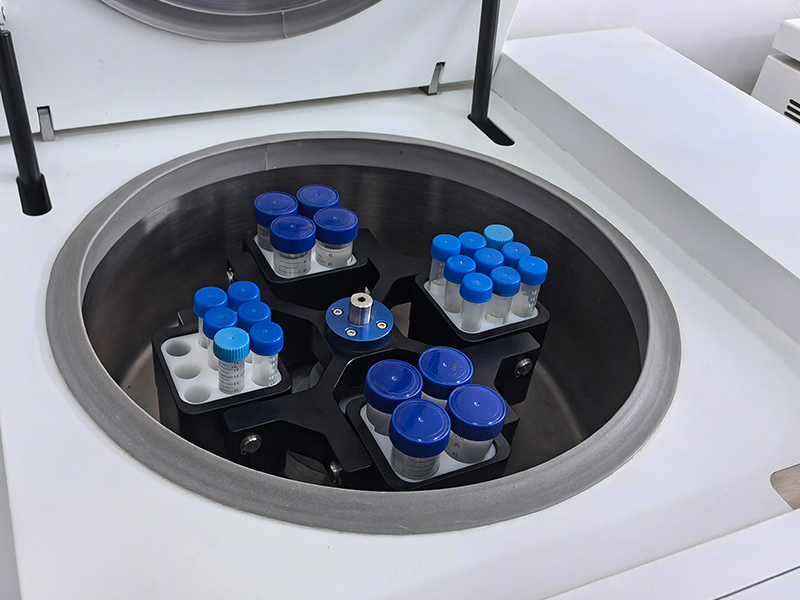
Centrifuge rotor adapters are not “simple accessories.” Material determines chemical compatibility, mechanical strength, and lifespan, while thickness controls centrifugal force accuracy, sample stability, and rotor balance.
Proper adapter selection, such as using WELSO Nylon adapters for precision or solvent-based experiments, ensures sample safety, reliable data, efficient workflows, and extended equipment life. Neglecting material and thickness compatibility may lead to experimental failure, equipment damage, or serious safety hazards.



info@welsotech.com
+86 21 51096910
Head Office: No. 439 Jinglian Road, Minhang District, Shanghai,China, 201108
Branch: 1-1009, National Industrial Design Park, No. 599 Jianzhu Road, Binhu, Wuxi , Jiangsu, China, 214062