
When a laboratory centrifuge develops a problem, many users immediately blame equipment quality or natural aging. However, declining performance, frequent error messages, abnormal vibration, and damage to critical components are not always caused by normal wear and tear. Improper operation and inadequate maintenance are also major contributors to premature equipment deterioration.
A laboratory centrifuge is a precision instrument designed to operate at high speeds. Its performance and reliability depend not only on the quality of its motor, rotor, and control system but also on how it is operated and maintained every day.
Some seemingly minor operating mistakes may not cause immediate problems. However, repeated over time, they can accelerate wear on critical components such as rotors, bearings, and motors. The consequences may include reduced operating accuracy, increased maintenance costs, and potential safety risks.
Here are five common centrifuge operating mistakes that laboratories should avoid, along with practical recommendations for preventing them.
1. Improper Sample Balancing: Increasing Mechanical Stress on the Rotor
Sample balancing is one of the most fundamental steps in centrifugation, yet it is also one of the most frequently overlooked.
Some laboratory operators assume that placing centrifuge tubes in approximately symmetrical positions is sufficient, even if their weights differ slightly. In reality, even relatively small weight differences can generate significant imbalance forces when the rotor spins at high speeds.
Common sample balancing mistakes include:
● Placing tubes with different sample weights in opposite positions.
● Ignoring weight differences caused by variations in sample density.
● Failing to use appropriate balancing tubes when some rotor positions are empty.
● Loading tubes without following the specified symmetrical arrangement.
When a rotor operates under unbalanced conditions, uneven centrifugal forces place additional stress on the rotor shaft and bearings, resulting in excessive vibration and mechanical wear.
Initially, the centrifuge may only produce slight vibrations or unusual noise. If the problem continues, however, bearing wear may accelerate, affecting operating stability and potentially damaging the rotor or other mechanical components.
How to Prevent It:
Before every centrifugation run, use an electronic balance to check sample weights and ensure they fall within the weight tolerance specified by the manufacturer.
For multi-position rotors, always follow the recommended symmetrical loading arrangement. If some positions are left empty, use appropriate balancing tubes or counterweights as specified in the equipment manual.

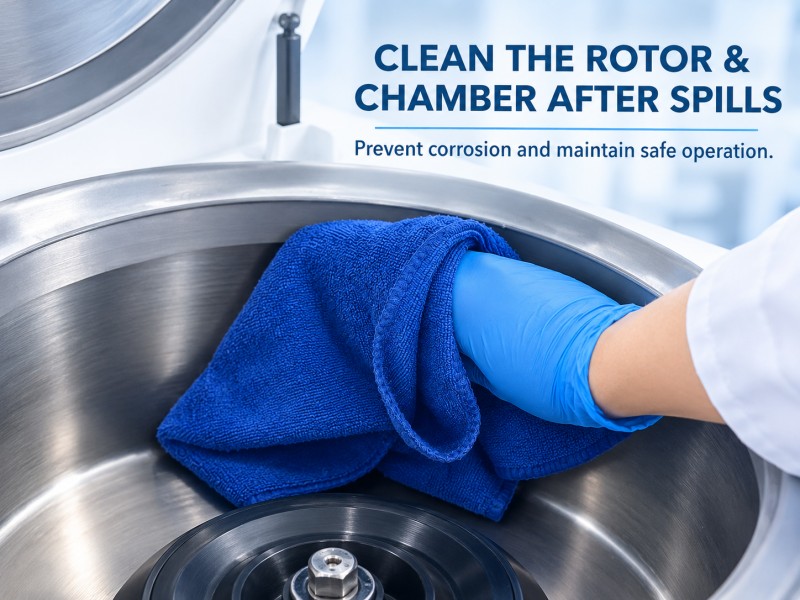
2. Failing to Clean Sample Spills: Allowing Corrosion to Damage the Rotor
Sample leakage can occur during centrifugation due to cracked tubes, overfilled containers, or improperly sealed caps.
Many laboratory operators clean only the visible liquid inside the centrifuge chamber, overlooking residues trapped in rotor cavities, tube slots, and other hard-to-reach areas.
Different laboratory samples have different chemical properties. Residues containing acids, alkalis, salts, or other potentially corrosive substances may cause material corrosion, pitting, or damage to protective coatings if left on the rotor for extended periods.
Corrosion and cracks that develop in less visible areas of a rotor can also compromise its mechanical strength and operational safety.
It is important to remember that the rotor is a critical safety component of a centrifuge. If severe corrosion, cracks, or structural damage are detected, the rotor should be taken out of service and inspected by qualified personnel. Simply cleaning the surface does not make a damaged rotor safe to use again.
How to Prevent It:
● Clean the rotor and centrifuge chamber promptly whenever sample leakage occurs.
● Select cleaning agents and disinfectants compatible with the rotor material.
● Dry the rotor according to the manufacturer's recommendations after cleaning.
● Regularly inspect the rotor for corrosion, cracks, and deformation.
● Stop using any rotor that shows signs of structural damage.
Keeping the rotor clean not only helps extend its service life but also plays an important role in maintaining centrifugation safety.
3. Overloading and Exceeding the Rated Speed: Accelerating Component Wear
Every laboratory centrifuge has specified operating limits, including rated speed, maximum capacity, compatible rotor configurations, and operating time requirements.
However, in an effort to improve laboratory efficiency, some users may overload the rotor, install incompatible rotors, or operate the centrifuge continuously for extended periods without considering its operating limitations.
These practices increase the workload on the motor, bearings, and drive system, potentially resulting in:
● Increased motor and bearing temperatures.
● Accelerated wear of mechanical components.
● Reduced operating stability.
● Reduced speed control accuracy.
● Frequent error messages or automatic shutdowns.
One important point to remember is that a centrifuge's maximum speed and maximum capacity cannot necessarily be achieved simultaneously. Different rotors have their own rated speed limits and maximum load capacities. Therefore, operating conditions should never be determined solely by the specifications of the centrifuge itself.
How to Prevent It:
Before operation, verify the rotor model, rated speed, maximum capacity, and compatibility requirements. Make sure all operating parameters comply with the manufacturer's specifications.
For laboratories that require frequent or extended centrifugation, select equipment designed to handle the actual workload. Avoid operating the centrifuge beyond its intended operating limits over long periods.

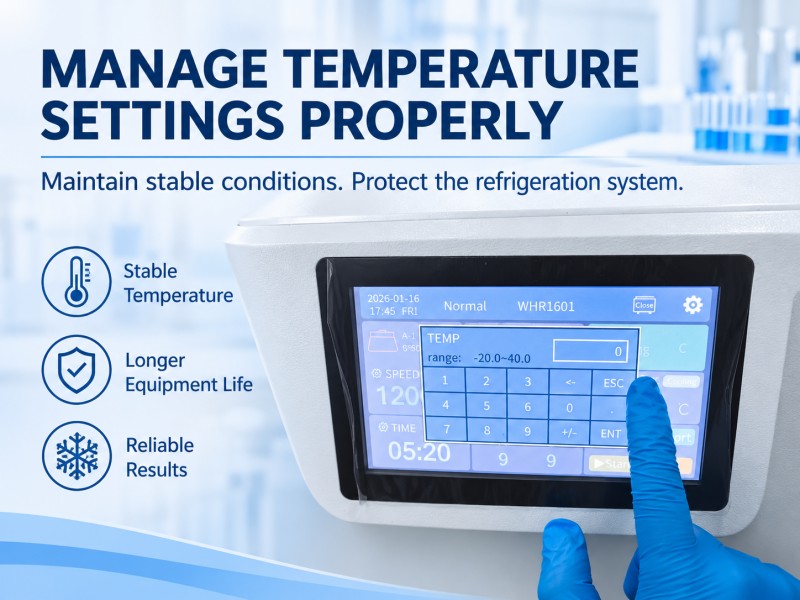
4. Improper Temperature Management: Affecting Refrigerated Centrifuge Performance
In addition to meeting speed and centrifugal force requirements, refrigerated centrifuges must maintain a stable temperature environment. Proper temperature management is therefore essential for both experimental consistency and equipment reliability.
Certain improper operating practices, such as frequently changing temperature settings, repeatedly starting and stopping the refrigeration system, or failing to follow recommended pre-cooling and shutdown procedures, may increase the workload on the refrigeration system.
In addition, when sample temperatures differ significantly from the preset temperature, the actual sample temperature during centrifugation may also be affected.
Poor temperature management over time may increase the likelihood of frost accumulation inside the chamber and condensation buildup.
How to Prevent It:
● Set the target temperature in advance according to experimental requirements and allow sufficient pre-cooling time when necessary.
● Choose an appropriate pre-cooling procedure based on sample temperature and experimental needs.
● Avoid unnecessary and frequent temperature adjustments.
● Clean the centrifuge chamber regularly and keep its interior dry.
● Follow the manufacturer's recommended shutdown procedure instead of disconnecting the power supply improperly.
Proper temperature management helps maintain consistent experimental conditions while reducing unnecessary workload on the refrigeration system.
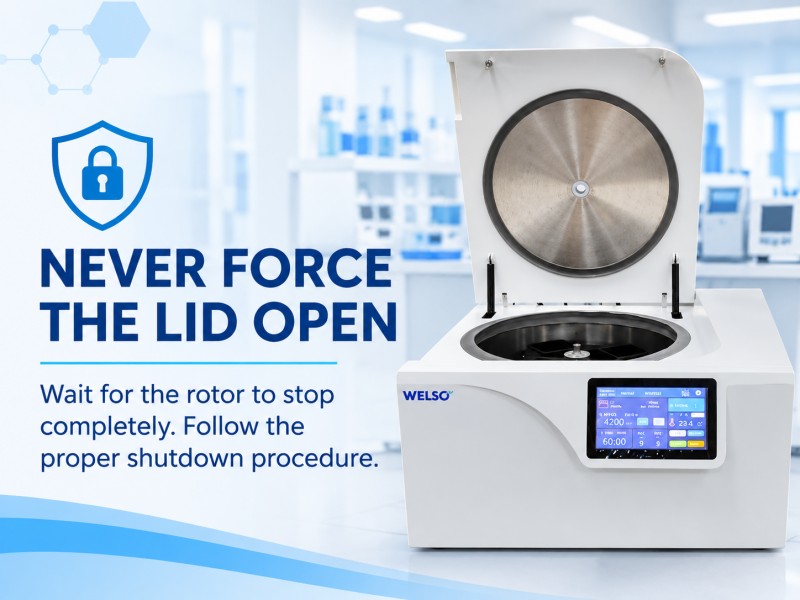
5. Forcing the Lid Open or Improperly Interrupting Operation: Ignoring Safety Protections
During centrifugation, the rotor generates considerable rotational inertia. Even after the motor stops driving the rotor, it may continue spinning for some time.
To save time, some operators may attempt to force the lid open, remove samples before the rotor has completely stopped, or frequently interrupt normal operating cycles.
These actions may damage the lid-locking mechanism, drive system, and braking components. More importantly, they create serious operational safety risks.
Opening a centrifuge before the rotor has completely stopped is particularly dangerous during high-speed operation, as rotating components and unsecured samples may cause injury to laboratory personnel.
How to Prevent It:
● Never attempt to force the centrifuge lid open during operation.
● Wait until the rotor has come to a complete stop before opening the lid.
● Never attempt to bypass or manually override the lid-locking protection.
● Avoid unnecessary interruptions and frequent start-stop cycles.
In the event of a sudden power failure, follow the manufacturer's emergency lid-opening procedure.
Modern laboratory centrifuges are generally equipped with safety features such as lid interlocks, automatic locking mechanisms, and other protective functions. Operators should use these features correctly and never attempt to bypass the built-in safety systems.
Conclusion: Proper Operation Is the Key to Extending Centrifuge Service Life
Laboratory centrifuges are widely used in clinical diagnostics, biomedical research, molecular biology, food testing, and many other laboratory applications. They play an essential role in sample preparation and separation.
The service life and operating stability of a centrifuge depend not only on manufacturing quality and component reliability but also on daily operating practices, maintenance routines, and proper rotor management.
To minimize unnecessary equipment wear, laboratories should establish standardized centrifuge operating and maintenance procedures:
● Check sample weights and ensure proper balancing before every run.
● Clean the rotor and centrifuge chamber promptly after sample leakage.
● Never exceed the specified speed, capacity, or operating limits.
●Maintain appropriate temperature settings and operating conditions for refrigerated centrifuges.
● Follow the correct startup, shutdown, and lid-opening procedures.
● Regularly inspect the rotor and other critical components.
Many equipment failures do not happen overnight. Instead, they develop gradually through repeated operating mistakes and inadequate maintenance.
Developing good operating habits can help laboratories reduce repair and replacement costs, improve experimental reproducibility, and maintain safer, more consistent sample preparation procedures.
Looking for Reliable Laboratory Centrifuge Solutions?
Welso offers a range of laboratory centrifuge solutions featuring different speed ranges, capacities, rotor configurations, and temperature control options to support diverse laboratory sample separation and preparation requirements.
Contact Welso to learn more about our centrifuge models and rotor configurations and find a solution that meets your laboratory's application needs.



info@welsotech.com
+86 21 51096910
Head Office: No. 439 Jinglian Road, Minhang District, Shanghai,China, 201108
Branch: 1-1009, National Industrial Design Park, No. 599 Jianzhu Road, Binhu, Wuxi , Jiangsu, China, 214062