
An ultrasonic homogenizer is a laboratory instrument that uses high-intensity ultrasonic waves for cell disruption, sample homogenization, particle dispersion, liquid emulsification, and protein extraction.
Its working principle is based on the cavitation effect generated by ultrasonic waves in liquids. Microscopic bubbles rapidly form and then collapse instantaneously, releasing localized high-intensity energy and shear forces. This effectively disrupts cell structures, disperses particles, and promotes sample homogenization.
An integrated ultrasonic homogenizer combines the ultrasonic generator, transducer, probe, and operating platform into a compact unit. It offers convenient operation, a compact footprint, and precise parameter control. These features make it widely used in biochemistry, microbiology, pharmaceutical chemistry, surface chemistry, zoology, and other laboratory research fields.
Ultrasonic Generator
The ultrasonic generator is the control center of an ultrasonic homogenizer. It converts input electrical energy into high-frequency electrical signals and drives the transducer to generate ultrasonic vibrations.
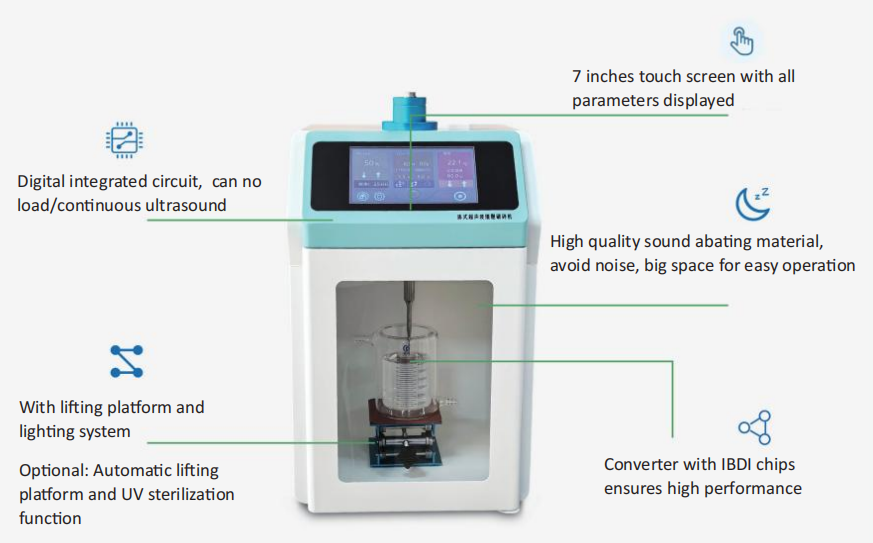
Its main functions include:
Digital power control: Adjusts ultrasonic power according to sample characteristics.
Time control: Enables precise setting of the operating time.
Pulse mode: Allows users to set ultrasonic working and interval times.
Automatic frequency tracking: Matches the resonant frequency of the transducer in real time to improve energy output efficiency.
Safety protection: Provides overload, over-temperature, and fault protection.
By precisely controlling power, time, and operating modes, the ultrasonic generator can meet the cell disruption and homogenization requirements of different samples.
Piezoelectric Transducer
The piezoelectric transducer is the core energy conversion component of an ultrasonic homogenizer.
When the transducer receives a high-frequency electrical signal, the internal piezoelectric ceramic material produces mechanical vibrations through the inverse piezoelectric effect. The electrical energy is converted into mechanical energy, which is then transmitted to the sample through the probe.
The conversion efficiency and operational stability of the transducer directly affect the output of ultrasonic energy. Therefore, a high-performance transducer is an important foundation for achieving efficient cell disruption.
Probe (Ultrasonic Horn)
The probe, also known as an ultrasonic horn, is a key component that directly transfers ultrasonic energy into the sample.
The probe is typically made of TC4 titanium alloy, which offers excellent corrosion resistance and fatigue resistance. Some probes can also be sterilized under high-temperature and high-pressure conditions, making them suitable for applications with strict cleanliness requirements.
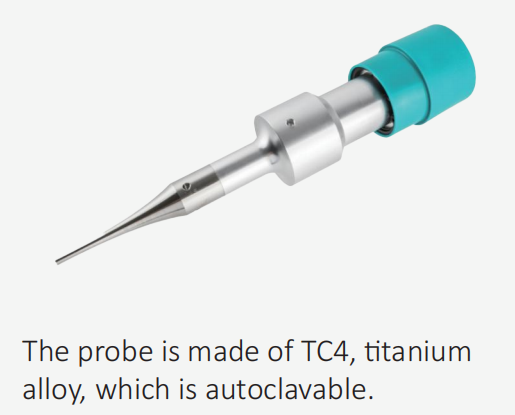
Its main functions include:
Amplifying Ultrasonic Vibrations
Through specialized structural design, the probe amplifies the vibration amplitude, increasing the concentration of ultrasonic energy and improving sample processing efficiency.
Generating a Strong Cavitation Effect
The probe directly transfers high-frequency mechanical vibrations into the liquid sample, promoting the formation and collapse of cavitation bubbles. This generates intense shear forces and impact forces for efficient cell disruption and sample processing.
Adapting to Different Sample Volumes
Different probe specifications can be selected according to sample volume and processing requirements, including:
Φ2 mm, Φ3 mm, Φ6 mm, Φ8 mm, Φ10 mm, Φ13 mm, Φ15 mm, Φ20 mm, and Φ22 mm.
Small-diameter probes are suitable for processing micro-volume samples, while larger-diameter probes are designed for larger sample volumes.
Sample Container Adapter
Integrated ultrasonic homogenizers are typically equipped with adjustable supports, clamps, or lifting platforms for securing different types of sample containers.
Common containers include:
Centrifuge tubes
Beakers
Glass sample cups
Other laboratory sample containers
The sample fixation structure helps keep the probe vertically immersed in the liquid and reduces the risk of contact or collision between the probe and the container wall.
Some instruments can also be equipped with lifting platforms, lighting systems, automatic lifting platforms, and UV sterilization functions to further improve operational convenience.
Intelligent Control Panel
Modern ultrasonic homogenizers typically use digital control systems.
The WUH Series features a 7-inch touchscreen interface that can display and set:
Ultrasonic power
Operating time
Ultrasonic frequency
Pulse time
Sample temperature
Current operating status
Alarm information
Users can select either continuous ultrasonic operation or pulsed ultrasonic operation according to the characteristics of different samples.
For example:
Ultrasonic operation for 2 seconds / Stop for 3 seconds
This pulse mode helps maintain high cell disruption efficiency while reducing continuous heat accumulation during processing.
Some instruments also support program storage, allowing users to quickly recall the same parameters during repeated experiments, thereby improving experimental repeatability and standardization.
Temperature Control System
During ultrasonic cell disruption, part of the mechanical energy is converted into heat. If the instrument operates continuously for an extended period, the sample temperature may increase.
For proteins, enzymes, and other heat-sensitive samples, excessive temperature increases may affect their activity and experimental results. Therefore, temperature control is an important part of the ultrasonic disruption process.
Common temperature control methods include:
Pulsed Ultrasonication
By setting working and interval times, the sample is given a certain amount of time to dissipate heat between ultrasonic cycles.
Ice Bath
The sample container is placed in an ice bath to reduce the heat generated during ultrasonic processing.
External Cooling
A cooling water bath or external circulating cooling system can be used to control the sample temperature.
The WUH Series supports sample temperature monitoring and temperature control options within a range of 0–100°C, making it suitable for sample processing applications with different temperature requirements.
Main Applications of Ultrasonic Homogenizers
Through the cavitation effect and mechanical shear forces generated by high-intensity ultrasonic waves, ultrasonic homogenizers can be used for:
Cell disruption and cell lysis
Protein extraction
Nucleic acid shearing
Tissue homogenization
Particle dispersion
Liquid emulsification
Sample mixing
Liquid degassing
They are widely used in:
Biochemistry
Microbiology
Pharmaceutical chemistry
Surface chemistry
Zoology
Other laboratory research fields
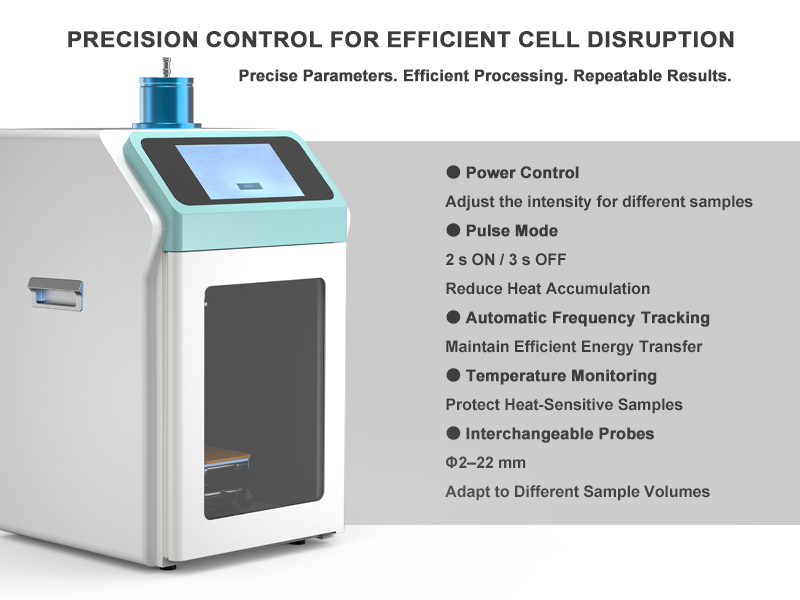
An ultrasonic homogenizer achieves efficient cell disruption and sample processing through the coordinated operation of the ultrasonic generator, piezoelectric transducer, and probe. The system converts electrical energy into high-intensity mechanical vibrations and utilizes the cavitation effect in liquids to efficiently disrupt cells and process samples.
The integrated design, combined with digital control, automatic frequency tracking, pulsed ultrasonication, and temperature control functions, makes the ultrasonic cell disruption process more precise, stable, and efficient.
By selecting the appropriate ultrasonic power, operating time, pulse mode, probe specification, and temperature control method, users can obtain more stable results in cell disruption, tissue homogenization, and other sample processing applications according to the characteristics of different samples.



info@welsotech.com
+86 21 51096910
Head Office: No. 439 Jinglian Road, Minhang District, Shanghai,China, 201108
Branch: 1-1009, National Industrial Design Park, No. 599 Jianzhu Road, Binhu, Wuxi , Jiangsu, China, 214062